
Understanding Human Capacity in High-Pressure Environments
At a recent Serco Justice and Immigration professional development conference, Jules delivered a keynote exploring how human capacity shapes decision-making under pressure.
Drawing on neuroscience, behavioural psychology and operational experience, the session examined how the brain, body and nervous system interact in high-demand environments — and why understanding these biological responses is essential for maintaining clarity, professional judgement and calm authority when pressure rises.
Read Full Article Here


When Survival Looks Like Competence - It Gets Rewarded.
Towards the end of November, I went quiet. Not deliberately or strategically, it just happened instinctively.
Not because I had nothing to say, and not because anything dramatic had gone wrong.
Life had become very full, and I did what most high-functioning people are exceptionally good at doing. I narrowed my focus, prioritised responsibility, and concentrated on keeping everything moving.
There was family stuff, work commitments, the pressure of wanting to get things right, and the emotional weight of preparing and delivering work that genuinely mattered to me.
At the time, I did recognise it as stress, and I was aware that survival patterns were in play. I have the language for that, after all.
But knowing what was happening didn’t stop me from pushing through it. I normalised it. I justified it. I told myself this was just one of those intense periods and that I could handle it.
With a little distance, though, I can see something much more important was happening.
That period marked the beginning of a quiet withdrawal. Not from life, but from myself.
My attention had shifted outward. I was listening less and managing more. And somewhere along the way, sharing posts on socials started to feel like something I needed to keep up with rather than something that actually meant something to me.
Here’s what’s become much clearer since then.
When survival shows up looking like competence, productivity, and consistency, it rarely gets questioned. In fact, it often gets rewarded.
But it also drains us.
So, I’m no longer interested in posting just to stay visible or because that’s what I “should” be doing. I’m not here to perform or keep pace with an unspoken expectation.
What I am interested in is sharing insights that have genuinely shifted something in me, because those are usually the ones that help other people see themselves more clearly too.
For me, this platform is about supporting 'my people'- the one's who are quietly stuck in high-functioning SURVIVAL. The overthinking, overworking, overanalysing and overfunctioning that passes as fine.
I'm not here to fix anyone.
But to help them notice what’s actually driving them, and to guide them back to a sense of safety in who they really are.
That realisation has fundamentally changed how I understand “high functioning”, and it’s the lens I’ll now be speaking from.
Because the most important question isn’t how well you’re coping.
It’s what’s actually driving you while you are.
When Success Meets Sustained Pressure
In this International Women’s Day feature for the Greater Birmingham Chambers of Commerce, Jules explores a challenge many high-achieving women quietly carry - the cumulative pressure of leadership, responsibility and life beyond work.
The article examines why the issue is rarely ambition or capability, but the biological and psychological load placed on the human system, and why strengthening human capacity has become essential for sustaining clear thinking, leadership and wellbeing in demanding environments.
Read Full Article Here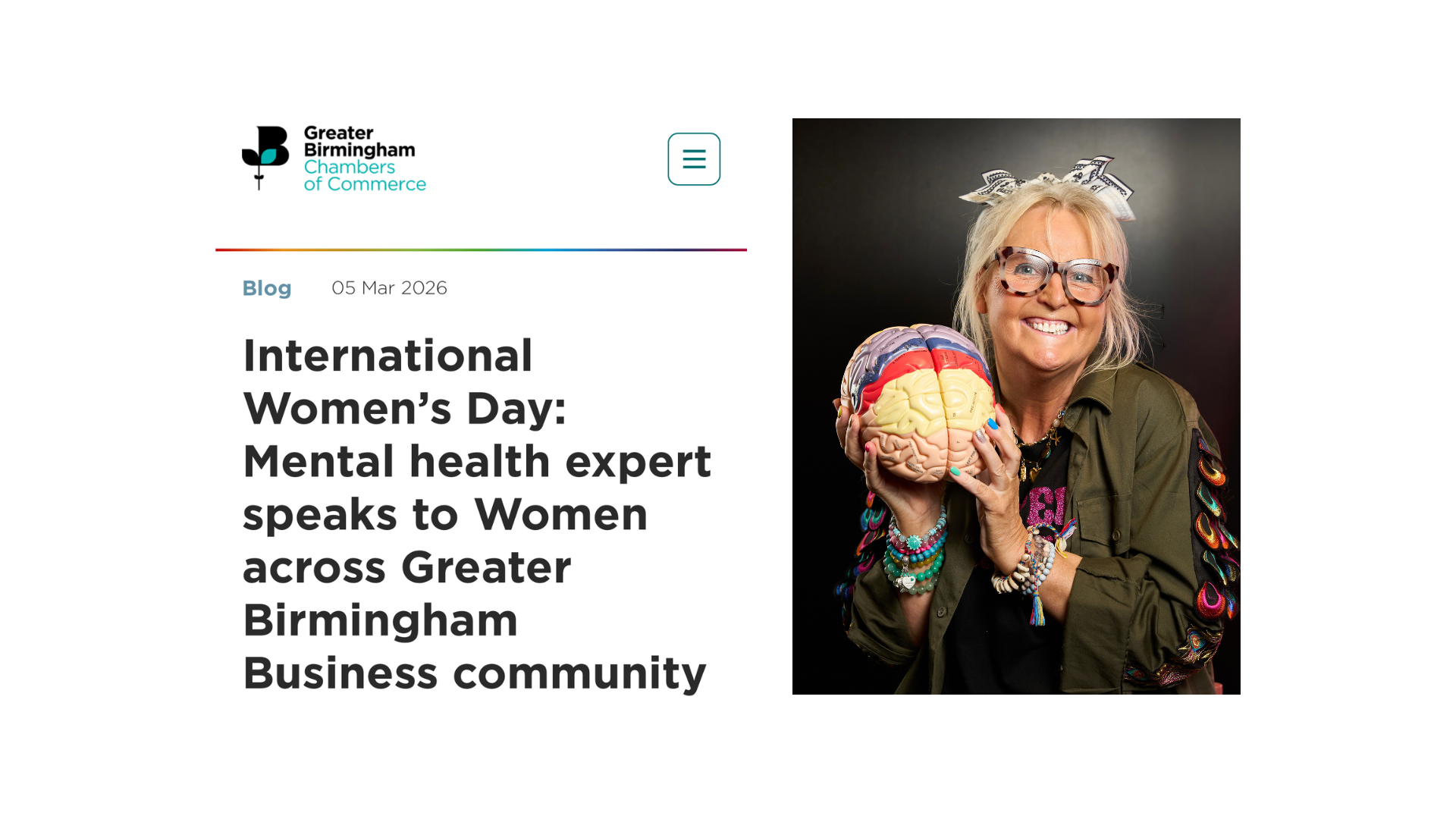

Emotional Economics
Yesterday I posted about my quiet withdrawal at the end of 2025, and my self reflection on high functioning survival traits. There’s another layer to all of this that I’ve been sitting with, and the phrase that’s circling in my mind is 'emotional economics'.
I didn’t go looking for it. It just appeared, as these things often do when you’re trying to make sense of something that’s been happening beneath the surface.
What I mean by it isn’t academic or theoretical. It’s very real and very human.
When you’re high functioning, capable, and used to carrying a lot, it’s surprisingly easy to start living on emotional and nervous system credit. You tell yourself you’ll deal with things later. When this season eases. When there’s more space. When life calms down a bit.
So you override the signals. You park the feelings. You borrow energy from tomorrow to get through today.
Not because you don’t know what you’re doing. Often you’re fully aware. You just trust yourself to cope. And for a while, that trust feels justified.
The work still gets done. The people are supported. The responsibilities are met. From the outside, it looks like competence, resilience, even strength.
But the body is keeping its own accounts.
I’ve been thinking a lot about the idea of body budgeting, something Lisa Feldman Barrett speaks about in her work. The nervous system is constantly managing resources, predicting demands, and trying to keep us within a sustainable range of energy and capacity.
The thing is, there’s no immediate alert when you overspend. No clear moment where you’re told you’ve gone too far. You just keep withdrawing from the same account and assuming you’ll pay it back later.
And later feels harmless. Neutral. Like it will take care of itself.
Except it doesn’t.
Interest accumulates quietly.
And eventually the cost shows up. Sometimes as exhaustion that rest doesn’t quite touch. Sometimes as anxiety that feels bigger than the situation in front of you. Sometimes as a dull loss of joy or clarity. Sometimes simply as the sense that you’re no longer fully at the wheel of your own life.
What I’m seeing much more clearly now is that high functioning survival isn’t usually about falling apart. It’s about deferring the cost. We assume that being capable somehow cancels out consequence. It doesn’t. It just delays the moment when the body asks for repayment.
So, the question I’m holding now isn’t whether I can cope.
It’s what I might be quietly putting on credit, assuming I will deal with the cost later.
That realisation has shifted how I understand stress, resilience, and what high functioning actually means. Because being capable doesn’t make the cost disappear. It just moves it into the future.
And at some point, the body stops extending credit and the bill lands where it always does, in the body.

The Standards Quietly Running Your Life - A Thought Leadership Article by Jules Mitchell.
This weekend I did something most people never think to do. I reviewed my personal Standard Operating Procedures.
Not for my business. For myself.
Most organisations have SOPs. They define how things are done, what is acceptable, how decisions are made and how pressure is handled. They exist because without clear standards, drift happens.
On Sunday afternoon I deliberately sat down and reviewed mine. Not my ambitions. Not my workload. Not my goals.
My standards.
The reason I chose to do this is because something had slipped. The overworking had crept back in and the pushing harder was no longer strategic. A very old survival strategy in me had become loud and domineering, and it was driving in a way that no longer reflects who I am choosing to be.
That is usually my signal that it is time to recalibrate.
For clarity, I distinguish between Standard Operating Principles and Standard Operating Practices.
My principles are directional. They define the qualities I am committed to embodying and the standards I intend to uphold, particularly under pressure. They are the anchor points that guide how I want to think, lead and live.
My practices are behavioural. They are pre-determined responses. When a familiar pattern surfaces, this is how I will respond. When stress rises, this is the pathway I follow.
Principles establish direction. Practices protect it.
So I reviewed my standards for how I handle pressure, how I regulate emotion, how I protect recovery, the quality of my thinking, and the tone I use with myself when something stretches me. It is easy to speak about these things. It is far more challenging to live by them when an old pattern is shouting over them.
That is where practices matter.
If I feel my nervous system accelerating, what do I do? If I feel myself slipping into proving mode, what is my rehearsed response? If I am tired but tempted to override it, what practice brings me back?
In sports psychology there is the concept of mental rehearsal. You practice a response repeatedly so that when the moment arrives, your system already knows the pathway. I think of my Standard Operating Practices in the same way. They are rehearsed choices, installed in advance, so that I am not negotiating with myself in the heat of the moment.

There is a well-known idea that we do not rise to our goals, we fall to the level of our systems. I would add that we live to the level of our standards. If they are unclear or unexamined, older patterns often decide for us.
When pressure rises in your world this week, notice what standard actually governs your behaviour.
Not the one you aspire to. The one that consistently shows up.
That is your real operating system.
And if it no longer reflects who you are choosing to become, it may be time to rewrite it.

High Functioning Survival.
Over the past couple of days, I’ve been talking about high-functioning survival and the cost it quietly carries. Not the dramatic kind, but the version that looks like coping, competence and keeping everything moving while something underneath slowly gets depleted.
This is a continuation of that conversation, because something this week helped me see one of the ways that cost shows up, especially for people who are very capable at holding things together.
I had a message from one of my Untethered retreat attendees. She said that even though she’d only met me once, my honesty about my own life experiences made the work feel real rather than theoretical. It helped her trust what she was feeling instead of questioning it or trying to perform being “fine”.
And then she said something else almost in passing. She told me she had never met anyone with such strong perfectionism.
That stopped me. Not because it felt critical or unkind, but because it was true. And it helped me see something I think many high-functioning people miss, including me.
This wasn’t obvious, harsh perfectionism. It was the high-functioning kind. The version that looks like care, responsibility and depth. The kind that shows up when the work matters, the people matter, and letting things drop doesn’t feel like an option.
And the problem is, it works. You don’t fall apart. You don’t crash. From the outside, you look like you’re doing well.
But the cost is still there.
It shows up as never quite being satisfied with what you’ve produced, even when others say it’s good. It shows up as replaying what you delivered and thinking it could have been better. As adding more, refining more, pushing harder, not because it’s needed, but because some part of you is still trying to prove your worth or stay ahead of criticism.
This is where Little Miss or Master Perfectionist often steps in. One of many protector states that learned early on that staying switched on and self-correcting was the safest way to be.
On the surface, life keeps moving. The work gets done. But underneath, something starts to feel thinner and more effortful than it used to.
This has been my own work recently. Not fixing myself or getting rid of perfectionism. Just noticing when she’s driving and getting curious about what my nervous system actually needs instead of overriding it.
So, if you’re reading this and recognising an over-active Little Miss or Master Perfectionist in yourself, hear this clearly. There is nothing wrong with you. These parts didn’t appear by accident.
As nervous system regulation and inner safety increases, they don’t disappear entirely, they just don't sit in the drivers seat as often! They quieten. And they stop running the whole show.
That’s where real capacity begins.
Sunday Night Scaries - A Thought Leadership Article by Jules Mitchell.
Hi, this is Jules checking in on what I feel will be a regular Sunday evening slot. I’ve chosen this time intentionally, because there are so many people I meet who are living in what I call SSB; Subconscious Sunday Bracing™, often without ever realising it.
But before I continue, I must be very British and mention the weather. Did you see the sunshine? ☀️ Yesterday was glorious, and even today there have been patches of blue sky and glimmers of sun breaking through. It’s remarkable how something as simple as light can shift our internal state so quickly.
The world can feel so different through a slightly different lens.
And that’s exactly what I want to talk about.
There is a familiar shift that begins as Sunday evening unfolds, where part of you is no longer fully here and has already started moving into tomorrow, running through what is waiting, what needs to be carried, what cannot be dropped, and even though nothing has actually happened yet, the nervous system has begun preparing, holding a quiet layer of readiness in the background.
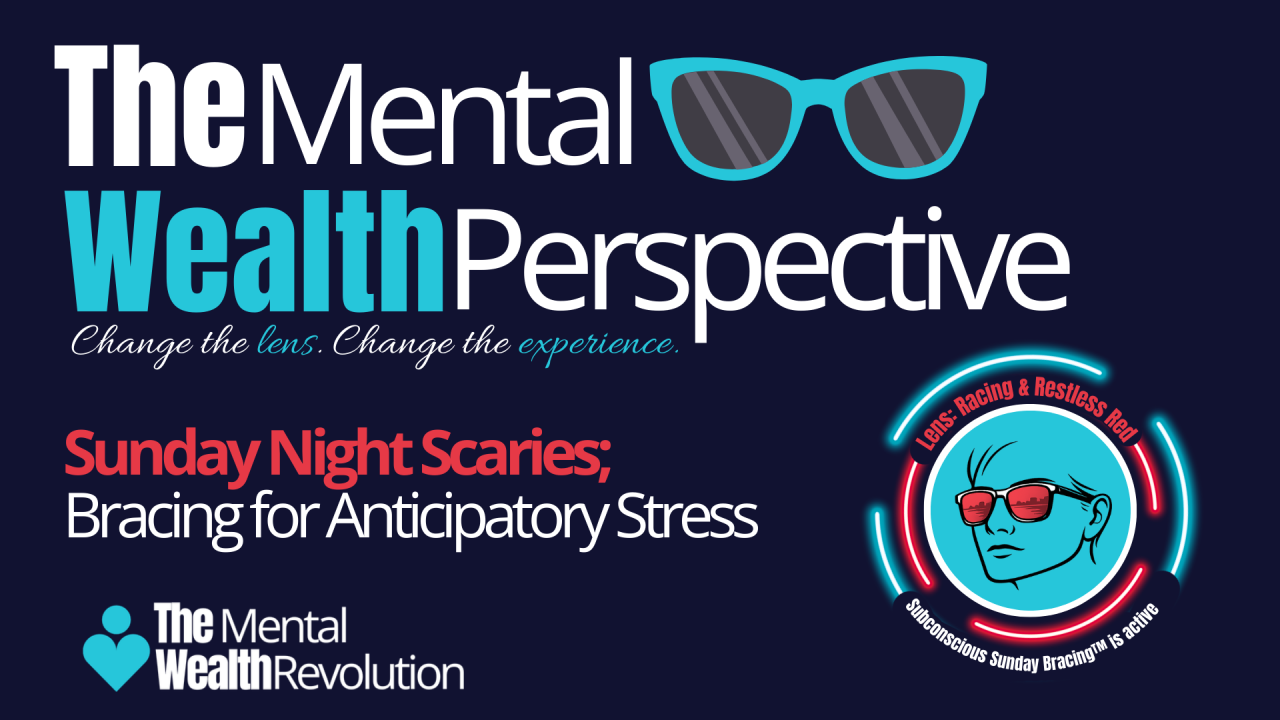
This has been softened into something called the Sunday Night Scaries, but what it actually reflects is Subconscious Sunday Bracing™ (SSB), a predictive survival response where the nervous system begins preparing early for the load it expects is coming.
This is anticipatory stress; the body’s intelligent attempt to forecast demand based on lived experience, and when demand has been sustained for long enough without genuine recovery, the system stops waiting for Monday morning and begins preparing early, holding a background mobilisation that often becomes so familiar it simply feels like normal life.
Through the Mental Wealth Perspective, and using our Shades of Self™ model, this state often reveals itself as the Racing & Restless Red lens, where the nervous system is already mobilising for what lies ahead, allocating energy, sharpening attention, and preparing you to meet what comes next.

What sits underneath this is adaptation, an extraordinarily intelligent nervous system that has learned through repetition that it needs to stay ready, conserving energy and bracing in advance of anticipated demand.
Once you recognise SSB in your own system, you begin to see how much of your life may have been lived in preparation for what might happen, rather than in full contact with what is actually here. Your Survival System has taken control of the wheel and is subconsciously driving your life.

That’s all for now. I’ll be back next week to share more Mental Wealth Perspectives.
And if you recognise Subconscious Sunday Bracing operating within your own system, and you're ready to change the way your nervous system predicts and prepares, you might want to check out one of our LIFE LABS.
Your Attention Isn't Neutral
We spend a lot of time trying to improve performance without ever asking what’s driving it.
Much of what we call stress, overthinking or pressure isn’t a lack of capability. It’s the result of automatic systems directing our attention towards what feels most urgent or threatening.
Your attention is not neutral.
Whatever it’s trained on, your brain will keep scanning for more evidence of.
That’s not positive thinking or mindset work.
That’s biology.
The most useful question I’m seeing right now isn’t “how do I cope better?”
It’s “what’s driving my attention while I’m coping?”
That awareness alone changes behaviour.